![[FISH]rx Logo in Black](https://fish-rx.com/wp-content/uploads/2025/07/FRXLOGO-BLK.png)
Color is one of those things that every angler has an opinion on and nobody fully agrees on. Especially when it comes to soft plastic colors SoCal throws at you — the variables are real and there’s rarely one right answer. What there is: a framework for making better decisions faster, so you’re not just guessing every session.
This guide covers how to choose soft plastic colors SoCal conditions actually reward — clear versus stained water, time of day, seasonal shifts, and the specific colors from the [FISH]rx lineup that have earned their place in the rotation. Including a few that look wrong on paper but keep catching fish. If you want to pair this with rigging, check out the paddle tail rigging guide to cover weights, hooks, and retrieves for the most common presentations.
How to pick soft plastic colors SoCal bass actually respond to
The first thing to assess when you get to the water is visibility. Gin clear and stained are the two extremes — most days you’re somewhere in between, and your color logic adjusts accordingly.
Clear water is actually harder to fish. Spotted bay bass are both predator and prey, and in high visibility conditions they tighten up to structure and spook more easily. That’s why a slight stain in the water can work in your favor — it gives them more confidence to move off their holes and be aggressive. In stained water, go darker so the bait casts a shadow and reads as a profile, or go high-glitter and high-saturation so any light that does penetrate catches the flash. Scent, sound, and vibration all matter more when visibility is low.
Stained water helps bring up the confidence of bass to leave their holes a little bit more and potentially be a little more aggressive.
In clear water, start natural. Chovie, Lavender Shad, Smelt, Cosmic Shad — baitfish profiles that match what’s already in the water. Slow things down and keep the bait close to structure. That said, naturals aren’t the only option. Sometimes a reaction color in gin clear water triggers a fish that’s ignored everything else. The fish don’t have to follow any rule you set for them.
Current as structure
When current is running, think of the current break as structure. Fish will stage on the quiet side of the flow and ambush prey getting swept past. That ambush position also means they’re more willing to commit. Current also aerates the water, which can fire up the bite. When you see current pushing through, fish the break, not just the structure underneath.
Light conditions and time of day
When the sun comes up, the bite typically slows. More visibility means more predator pressure on the spotties, so they compress tighter to structure and become more selective. Go lower, go slower, and keep the bait near the bottom. Darker colors during the day aren’t wrong either — a bait that casts a shadow gives them something to hone in on.
At night, treat it like stained water. Visibility drops and the rules shift — fish can rely on lateral line more than sight. Dark colors at night is the rule of thumb, but it isn’t absolute. Some of the most aggressive bites happen around dock lights, where baitfish congregate and everything feeding on them is keyed into the light edge. In that situation, something with a pearl belly or a glitter component can work well because it catches the light and reads as bait.
Does color change by season?
Sort of — but it’s less about color and more about profile. As water cools in fall and winter, spotted bay bass shift from feeding heavily on fin bait toward a more crustacean-heavy diet. Their metabolism slows with water temperature, so they’re looking for calorie-dense meals rather than chasing fast-moving bait. That’s when a craw profile can outperform a baitfish profile — the RX Skeleton Craw on a Texas rig or a Jika rig, or the drop shot paired with the RX Slug when fish are keyed into fin bait. The color of the craw still follows water clarity logic — go natural in clear winter water, add some flash in lower-vis conditions.
Winter water in the back bays tends to clear up significantly. That means going natural across the board is a smart starting point from January through March. Summer brings warmer, sometimes dirtier water — more flexibility in color, and fish that are more willing to chase.
That said, this is general guidance, not a rulebook. The fish don’t know what month it is, they feel the shifts in seasons. Action still trumps color. A bait that swims right and gets in front of their face will get bit regardless of the calendar.
Natural versus reaction colors — the real answer
Most guides give you the clean version: match the hatch in clear water, go bright in dirty water. That’s a fine starting point. Here’s what it looks like in practice.
Start natural. Chovie, Lavender Shad, Smelt, Wounded Soldier, Cosmic Shad, Watermelon Pearl — these are your baitfish presentations and they work across a wide range of conditions. They’re established for a reason.
But natural isn’t always what gets bit. Some days you can throw everything that should work and get nothing, then put on a bright unnatural color like, Sour Watermelon — a light green and light pink that’s loosely modeled after Sour Patch Kids — and start catching fish immediately. Sometimes the fish have seen too much of the normal presentation and something different gets their attention. Imagine looking at cheeseburgers all day and then a salad swims by. There’s no science behind it, but that’s what it feels like.
Lavender Shad has both a dark presence and a light attribute to it. It throws a shadow but also gives them a bright color to hone in on.
Lavender Shad specifically works well when the naturals aren’t getting bit because it does two things at once. Dark back and chartreuse lateral line gives it a shadow and a bright accent. It’s not perfectly imitating anything, though the chartreuse line isn’t far from what an inshore striped crab looks like. Whatever the reason, it produces in conditions where straight natural colors go quiet.
The other thing about reaction colors — nuclear apple is chartreuse green with a black tail. It is objectively not a natural color. It also catches fish. The theory is territorial aggression, or novelty, or just that it’s so bright they react before they think. It doesn’t produce every session, but when it’s on, it’s on.
Which soft plastic colors SoCal species respond to
There are all-around colors that work across calico, spotted bay, and sand bass — natural baitfish presentations like Chovie, Smelt, Lavender Shad, and Cosmic Shad are solid regardless of which species you’re after. But there are a few species-specific considerations worth knowing.
Calico bass
Calico respond well to reds. Calico Special and Calico Candy both have deep red hues and produce on the wall and around rocky structure. Calico are also known squid eaters — they share habitat with sand bass on deeper structure where squid are present. That opens the door to pearl whites and translucent presentations.
Calico also give you the opportunity to throw bigger. A 10-pound calico is possible which means you can throw big baits and have big results. Throwing big baits will get bit in the harbors but it limits the bites you will get — spottie are aggressive and will eat the 5.5″ paddle tail and the 6″ slug. I have also seen spotties eat the 8″ slug. When you’re targeting calico specifically, go bigger than you would for spotties and fish with confidence. Like any fishing session change your baits and colors out and plan to fish the lures you have until something bites — listen to what the fish are telling you is working.
Sand bass
Sand bass eat squid. If you’re specifically targeting them on deeper structure or offshore, the Squid colorway — translucent white, translucent red, and a green color shift — can give you an edge. They respond to pearl whites in general, which matches the squid profile. What worked on the wall one year doesn’t always carry over — two years ago hot pink was a killer color, last year it was smaller presentations in red and orange. Pay attention to what’s working in the community and adjust.
Spotted bay bass
Clear water, slow presentations, natural colors — that’s the spotted bay bass color framework in one line. In the back bays at MDR and similar harbors, gin-clear conditions in winter are common, and fish that have seen a lot of pressure are going to be selective. Start with what matches what’s in the water, then work your way toward reaction colors if the naturals aren’t producing.
One area I’m still figuring out: whether spawn season changes color selection. From what I’ve heard, spotties get more aggressive looking to fuel up, which suggests you can throw almost anything at them. If you fish spotties through their spawn and have thoughts on color, reach out. I’d genuinely like to hear it. For the full spotty fishing breakdown — structure, presentation, and tournament context — the spotted bay bass guide is the place to start.
Key takeaways
The short version on soft plastic colors SoCal conditions call for:
- Read the water first, not the color chart. Clear water means natural and slow. Stained water means dark or high-saturation with added scent and vibration. Most days fall somewhere in between — let the fish tell you which direction to go.
- Seasonally, shift toward crustacean profiles in fall and winter when the water clears up and fish are feeding differently. Keep naturals as your baseline year-round and add variety from there.
- Start natural and move toward reaction. If the naturals aren’t getting bit, something unusual — Sour Watermelon, Nuclear Apple, anything the fish haven’t been looking at for weeks — can flip the session. The fish don’t know what color theory says. They just know what they haven’t seen.
For how color decisions play out in a real tournament session, Ep. 116 of Time on the Water covers the Spotty Bowl rotation start to finish.
Frequently asked questions
A few more questions on soft plastic colors SoCal anglers ask:
What color soft plastic works best for spotted bay bass in clear water?
Natural baitfish colors are your starting point in gin-clear conditions — Chovie, Lavender Shad, Smelt, or Cosmic Shad. Keep the presentation slow and the bait close to structure. If naturals aren’t getting bit, don’t be afraid to try something the fish haven’t seen. Sour Watermelon and similar off-beat colors have produced in clear water when the obvious choices went quiet.
Does water clarity really change which soft plastic color to use?
Yes, but it’s not the only variable. Clear water generally calls for natural profiles and slower presentations. Stained water opens the door to darker silhouette colors, high-glitter options, and more aggressive retrieves. Light conditions, current, season, and time of day all factor in too. The clearest water is usually in winter back bays — that’s when going natural matters most.
What soft plastic colors work for calico bass in SoCal?
All three inshore species respond to natural baitfish colors, calico included. Reds and deep warm tones tend to perform well on calico specifically — Calico Special and Calico Candy were developed around that. Calico share structure with sand bass on deeper water, so pearl whites and squid presentations are also worth having in the box when you’re on the wall or around rocky structure.
Is there a soft plastic color that works year-round in SoCal?
Chovie and Lavender Shad are as close to year-round colors as any in the lineup. Chovie works in clear water with small baitfish present. Lavender Shad has that combination of dark back and bright lateral line that produces across conditions and presentations. Neither one works every day, but both belong in the box regardless of season.
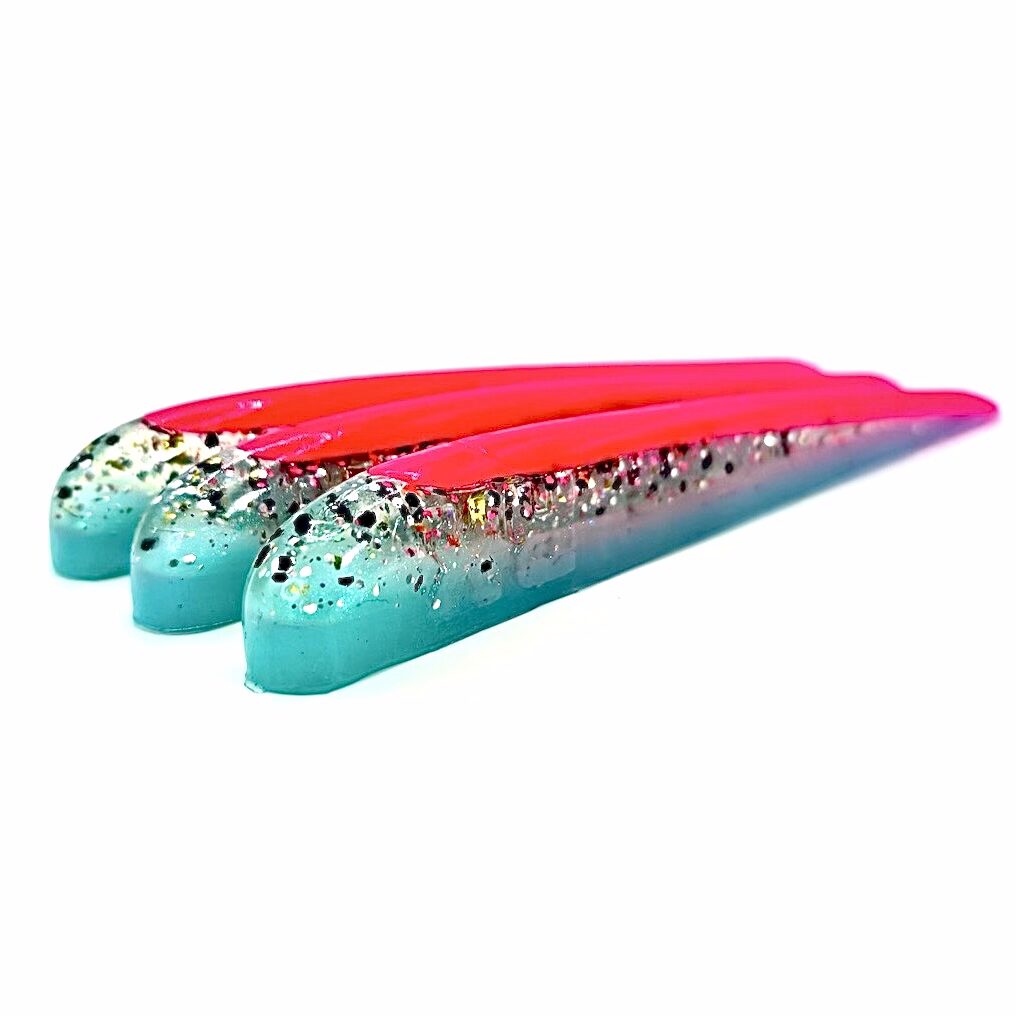
[FISH]rx Soft Plastics
The [FISH]rx lineup is poured in small batches in Los Angeles. Every color in the catalog is something I’ve thrown in SoCal’s back bays, harbors, and offshore structure.