![[FISH]rx Logo in Black](https://fish-rx.com/wp-content/uploads/2025/07/FRXLOGO-BLK.png)
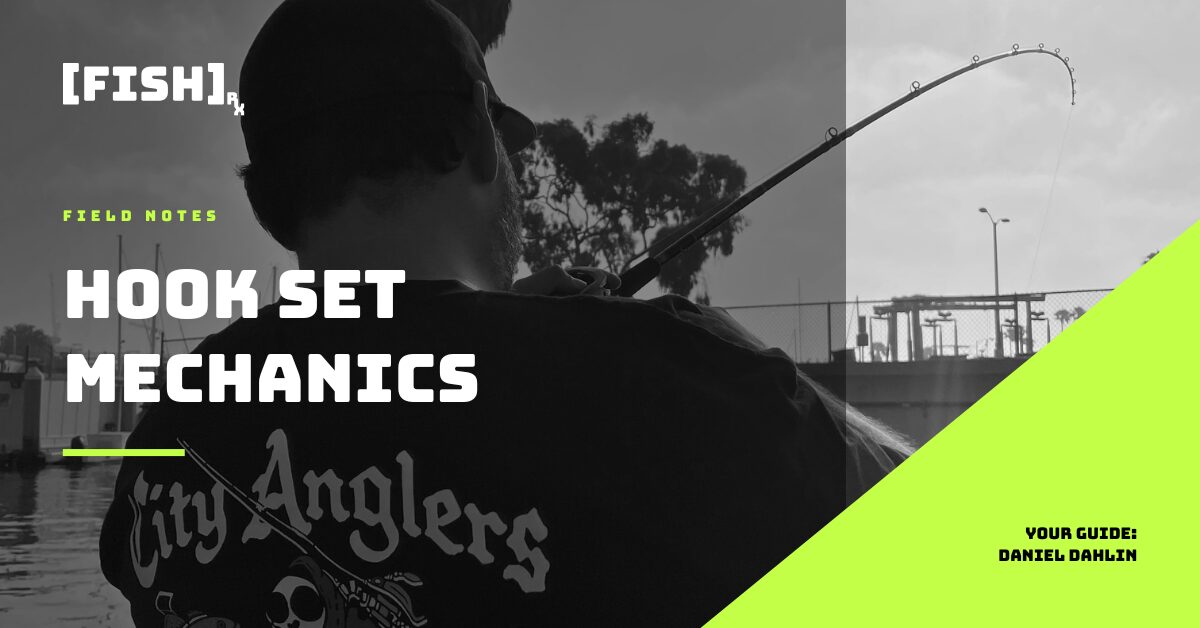
Most missed fish in SoCal inshore aren’t lost on the fight. They’re lost in the first second, when the angler swings hard and wonders why the fish wasn’t there. The mechanics of setting the hook in saltwater are different from freshwater. If you’re fishing braid, which most SoCal inshore anglers are, the rules change again.
This is the version Caesar from Toxic Baits broke down on Time on the Water Ep. 115. Thirty years fishing the Delta, now fishing SoCal’s harbors and back bays. He said it plainly: swinging hard gets you out of position. And once you’re out of position, you stop being able to reel. And if you can’t reel, you can’t drive the hook home.
Why the big swing doesn’t work on braid
Think through what happens mechanically when you swing for it. You load the rod, sweep it back hard, and your rod tip ends up somewhere behind your shoulder. You’re out of position. You can’t reel while you’re doing this. And the moment you stop swinging, there’s a pause: a fraction of a second where pressure on the fish goes to zero and the hook stops moving.
That’s when the fish spits it.
Braided line removes the stretch that monofilament anglers used to rely on to absorb the gap. With mono, a hard swing worked because the line would load and then spring forward, maintaining contact through the arc of the swing. Braid has almost no stretch. The hard swing just creates a directional jolt and then goes slack the moment you stop. That hard swing can cause the bait to rip out the mouth of the fish.
With braid, once you start coming tight, putting pressure on that fish; with steady pressure, you can keep up and drive that hook point home.
The wind-in — what it actually looks like
When you feel the bite, come tight. Don’t sweep. Keep the rod at a moderate angle (not straight up, not pointing at the fish) and start winding. You’re taking up slack and applying continuous pressure at the same time. The hook point moves steadily in one direction the whole time, which is exactly what drives it home.
If you want to add a pull on top of it, do it while winding. Not instead of winding. The pull-and-stop (where you yank the rod up and then pause to reel) is where fish get off. The moment the pull stops and the reel catches up, there’s a gap. Keep both moving together.
This feels wrong at first if you grew up watching bass fishing on TV. The dramatic hookset looks good on camera. But SoCal’s inshore bass are fast (spotted bay bass especially) and the bite happens and is over before most anglers have completed their backswing. By the time the rod has loaded and started moving backward, the fish has already felt something wrong and tried to spit it.
Treble hooks — an exception worth noting
Everything above applies to single hooks. Treble hooks are different. On a crankbait or bladed jig with trebles, a hard hookset can actually pull the hook points out of a soft bite. Reel into it, let the fish load the rod, then apply steady pressure. Don’t swing. The multiple hook points do the work as long as you keep tension.
When the swing makes sense
Caesar was clear about this: the swing-and-set isn’t wrong for every situation. If you’re fishing monofilament, a hard swing still works because the line loads the rod and carries momentum through. If you’re punching heavy mats vertically with a stout rod, a short upward pop drives the hook through the plastic. The rule is specifically about fishing braid on single hooks in SoCal inshore conditions, which is most of the fishing most people are doing here.
If you’re not sure which applies, start with the wind-in. It works in every situation where a hard swing works, and it works in situations where a hard swing costs you the fish.
Best presentations: anything that gets in the current break and stays there. A drop shot anchored just above the seam, a slow-rolled paddle tail working through the eddy, or a bladed jig fired into the current and swept back through the break naturally.
Why you’re breaking off the dock, not the fish
One more thing from that conversation worth putting down: most break-offs in SoCal harbor fishing aren’t fish pulling too hard. They’re bad casts. If you cast under a dock with too light a weight and the current drifts the line around a pylon before the bait hits bottom, you’re already hung. The hook set just confirms it.
Keep your line up when you’re fishing around structure. Fluorocarbon sinks. If there’s slack in the system and the line is draped across a rock pile or a pylon base, the fish isn’t your problem.
Key takeaways
- With braid, the wind-in replaces the swing. Keep tension moving in one direction the whole time. Don’t pull and stop, don’t swing and pause.
- Position matters. The moment you swing up and back, you lose the ability to reel, and steady pressure is what drives the hook home.
- Treble hooks need less force, not more. Let the fish load the rod.
- Most break-offs in harbor fishing are bad casts, not strong fish. Keep your line off the structure.
Frequently asked questions
Should you set the hook hard when fishing for spotted bay bass?
When fishing braided line (which most SoCal inshore anglers are) a hard swing often costs you the fish rather than landing it. The wind-in method keeps continuous pressure on the fish and drives the hook home more reliably than a sweep-and-pause. Hard hooksets work when you’re fishing monofilament with stretch, or punching heavy cover vertically. For most back bay and harbor fishing on braid, steady pressure while winding is the right call.
Why do I keep losing fish right after hookset?
Usually one of two things: either the rod tip went up and back without the reel following, creating a pause in pressure that let the fish shake the hook. Or the line was already compromised: draped across a pylon or nicked on a rock before the fish bit. Check your line regularly on rocky structure, and practice keeping the rod at a moderate angle and winding through the entire hookset rather than sweeping back.
Does the hook set change depending on what bait you’re using?
Yes. Single-hook presentations on braid use the wind-in method: steady pressure while winding, no dramatic sweep. Treble hooks on crankbaits and bladed jigs need even less force. Reel into the fish and let the multiple points work. Going too hard on trebles often pulls them out rather than driving them in. The principle stays the same across both: keep tension steady and moving.
![[FISH]rx RX Paddle Tail in Champagne Black Tip, 3.5" — handcrafted soft plastic bait for SoCal inshore bass](https://fish-rx.com/wp-content/uploads/2025/08/FRXPT-35-CBT-01.jpg)
RX Paddle Tail
The RX Slug and Paddle Tail are built to fish the way this guide describes: clean drop shot rigs, Texas rigs, and slow presentations around pylon structure where the wind-in hook set earns its keep.