![[FISH]rx Logo in Black](https://fish-rx.com/wp-content/uploads/2025/07/FRXLOGO-BLK.png)
SoCal inshore structure fishing puts you on spotted bay bass, calico, and sand bass in the same urban harbors most anglers drive right past. Pilings, rock edges, breakwalls, channel drops: this is some of the most productive inshore fishing in the state and it’s right outside your marina. If anything the fish prefer it. They stack up on the concrete and boats the same way they’d stack on a reef.
What makes it different from fishing open water is that the structure itself does a lot of the work. Your job is to understand which piece of structure holds fish, which presentation fits that structure, and how to adjust when conditions change. This guide covers all three.
The three structure types worth understanding
Not all urban structure fishes the same. Each type holds fish differently, requires a different approach, and responds to different baits.
1. Dock pilings and marina edges
This is the most common structure in any SoCal harbor … rows of pilings supporting docks, with boats along them. The fish hold in the shade under the docks and ambush from the shadows. They’re not randomly distributed. Specific corners, channel-facing edges, and spots where current deflects tend to hold fish consistently while the sections between them are often dead.
The key here is angles. You want your bait moving along the edge of the docks. When fishing pilings you want to hit the angles that you can, left, rigth and middle. Come at it from the side, keep the bait tracking as close as you can to the piling, and let the current help you. If the tide is moving, cast above your target and let the drift carry the bait into position. A 4-inch RX Slug on a drop shot in the shade of a dock is the most reliable starting point … slow, natural, and right in the fish’s face.
I fish every section I have access to. The fish might not be where you expect them … sometimes three fish come out of one corner and the next stretch of edge is completely dead. Move until you find where they’re sitting that day.
2. Rocky points and breakwalls
Breakwalls and rocky seawalls are calico and sand bass territory that can hold the occasional spotty. The rocks create current breaks, ambush points, and depth transitions all in one place. Fish hold tight to the rocks … sometimes right in the holes and ledges in the wall itself.
Crankbaits shine here in a way that can’t be described. The goal is bottom contact on every cast. Drive the bait down to the rocks, keep it grinding along the bottom, and work it back. Tie direct with a Rapala knot. Skip the clip. The loop knot preserves the wobble and lets the bait swing freely, which matters when you’re deflecting off irregular rock surfaces. Use 15lb fluorocarbon minimum at MDR … the rock piles run right up to the retaining wall and a big bass will find every crack and ledge on the way in.
All my fish have come from keeping the bait on the bottom. I drive it down on every single cast regardless of where I’m throwing. If you’re not hitting the bottom, you’re not fishing it effectively.
For rock structure, the bladed jig fishes well with a pop-and-pause cadence … burn it up off the rocks, pause it, let the trailer kick on the way down. When you slow roll it across rocks the blade ticks off the surface like a rattle, which is its own kind of trigger. The Cheapskate in heavier weights (3/4-ounce to 1-ounce) keeps you in the strike zone and gets the blade activated even at slower speeds close to the bottom.
3. Channel edges and open harbor structure
The channels that run through SoCal harbors are easy to overlook because there’s no obvious physical structure to target. But the edges where a channel drops off into shallower water are transition zones … and bass, halibut and other predatory fish, use them to stage and feed. Baitfish pile up on these edges and the bigger fish sit just below.
This is where covering water matters more than precision. The MDR C-Rig, the Cheapskate bladed jig, or paddle tail on an underspin lets you work the edge efficiently, covering distance while staying in the depth zone where the fish are holding. Size up on profile when you’re searching … a 4.5-inch or 5.5-inch RX Paddle Tail moves more water and gets noticed from further away than a finesse bait.
How current changes everything
The biggest mistake anglers make fishing urban structure is ignoring the tide. The same spot that’s dead on a slack tide can turn on the moment the water starts moving. Current does two things: it concentrates baitfish against structure and it activates the fish.
Fish into the current when you can. Cast above the structure so your bait drifts naturally into position. If current is sweeping your bait under a dock, let it … that’s exactly where the fish are sitting. When current is running hard, go heavier on your weight to stay near the bottom rather than fighting it. When it’s slack, drop down to the lightest presentation you can fish effectively and slow everything down.
Know where your current is going. Fish with it, not against it. If it’s pulling you off a spot you can always go heavier, or cast above and let it bring you in.
Line and leader for urban structure
MDR and most LA-area harbors are rocky. There are rock piles running right up to the seawall, and a fish that gets any momentum toward the structure can wrap you in a second. 15lb fluorocarbon is the starting point, not a suggestion. It’s the floor.
The other thing specific to MDR is the height of the seawall and some dock edges above the water. At low tide you might be looking at a 10-12 foot lift to get a fish up onto the wall. Anything below 15lb makes that genuinely risky. Play fish with more drag than you think you need so you can control the angle and bring them up clean.
Approach and noise
In gin-clear back bay water, fish can see further than you expect, and they can feel you coming. Long casts give your bait distance from where you’re standing, which matters more when the water is clear and still. Move quietly along structure and keep your profile low if you’re on a kayak or float tube. It might only be a one-percent difference … but fish enough spots and those percentages stack up.
That said, don’t overthink it to the point of paralysis. The bigger factor is whether you’re in the right section. A fish in a good feeding position in current will eat regardless. Save the extra stealth for when the water is clear, the tide is slack, and the fish have had time to get used to boat traffic.
Ep. 116 covers MDR harbor structure from a tournament angler’s perspective, covering how to read sections, when to switch presentations, and what actually got bit.
Key takeaways
- Dock structure: angles and current. Cast along the edge, not at it. Use the tide to carry your bait into position and let it sit in the shade.
- Rock structure: bottom contact is non-negotiable. Crankbait on a Rapala knot, 15lb fluoro minimum, grind it along the bottom. The bladed jig with a pop-and-pause cadence covers the same water with a different trigger.
- Channels and open harbor: cover water. RX Paddle Tail or MDR C-Rig to search the depth transitions efficiently. Size up when you’re looking for fish, size down once you find them.
Frequently asked questions
What’s the best bait for fishing dock pilings in Southern California?
A 4-inch soft plastic slug on a drop shot is the most consistent starting point for dock structure. Fish it slow, cast parallel to the piling line, and let the current do the work. The RX Slug in a natural color like Chovie 2.0 or Lavender Shad covers most back bay conditions. Switch to a bladed jig or paddle tail when you want to cover water faster between sections that are holding fish.
What line weight should I use for fishing SoCal harbor structure?
15lb fluorocarbon is the floor for most LA-area harbors and non-negotiable at MDR specifically. The rock piles extend right up to the retaining wall, and the seawall height at low tide means you’re lifting fish a long way. Go to 20-30lb when you’re targeting the wall directly or fishing the bladed jig in heavier cover.
When is the best time to fish marina structure in Southern California?
Moving tide beats slack tide almost every time. The window just before and after a tide change (when water is actively moving) is when structure fishing comes alive. Baitfish stack against pilings and rock edges when current is running, and the bass follow. Early morning on an incoming tide is the most reliable combination, but any moving water is better than none.
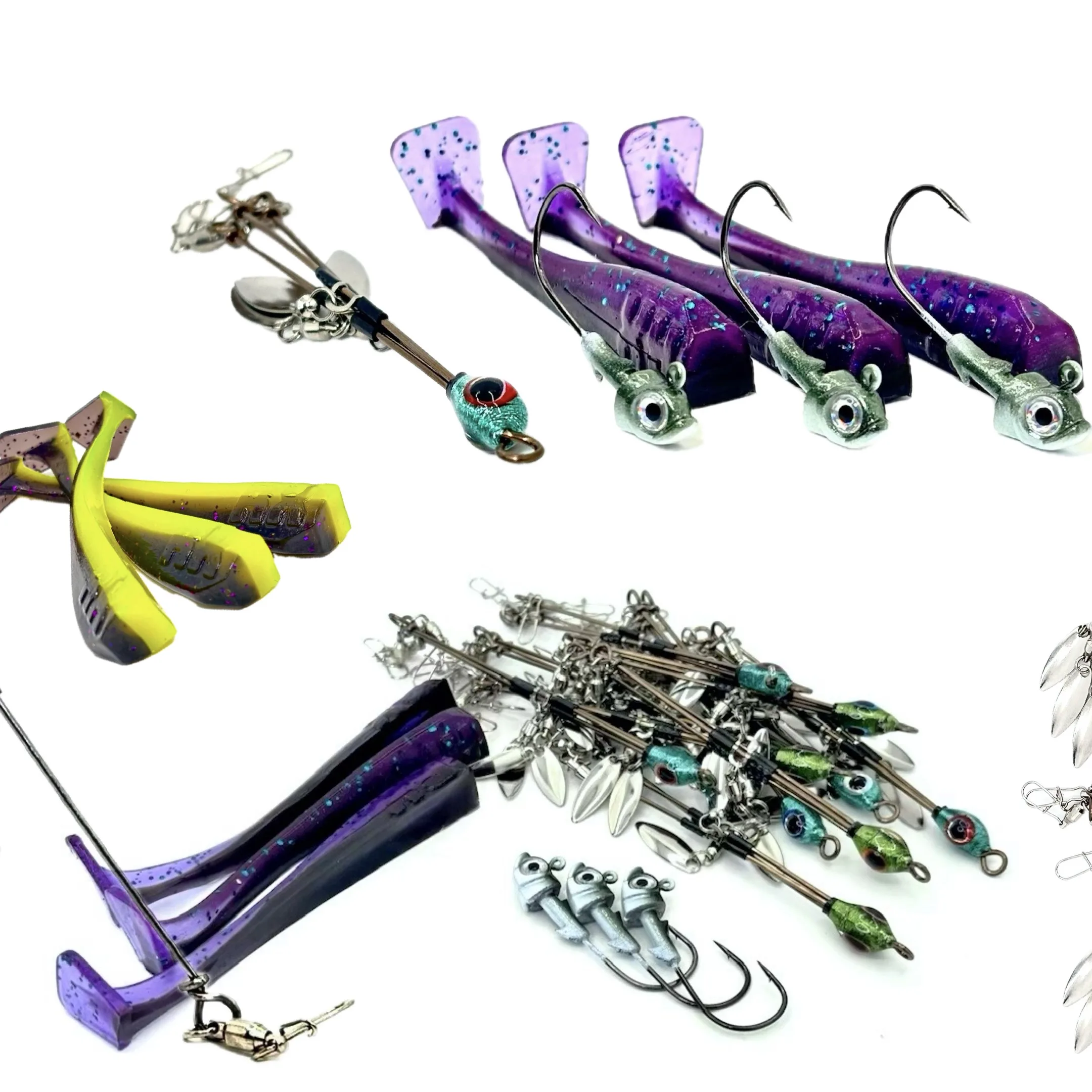
Built for SoCal Structure
The RX Slug, Paddle Tail, and Cheapskate bladed jig are all built for this fishery. Handcrafted in LA, tested on the same structure this guide covers.