![[FISH]rx Logo in Black](https://fish-rx.com/wp-content/uploads/2025/07/FRXLOGO-BLK.png)
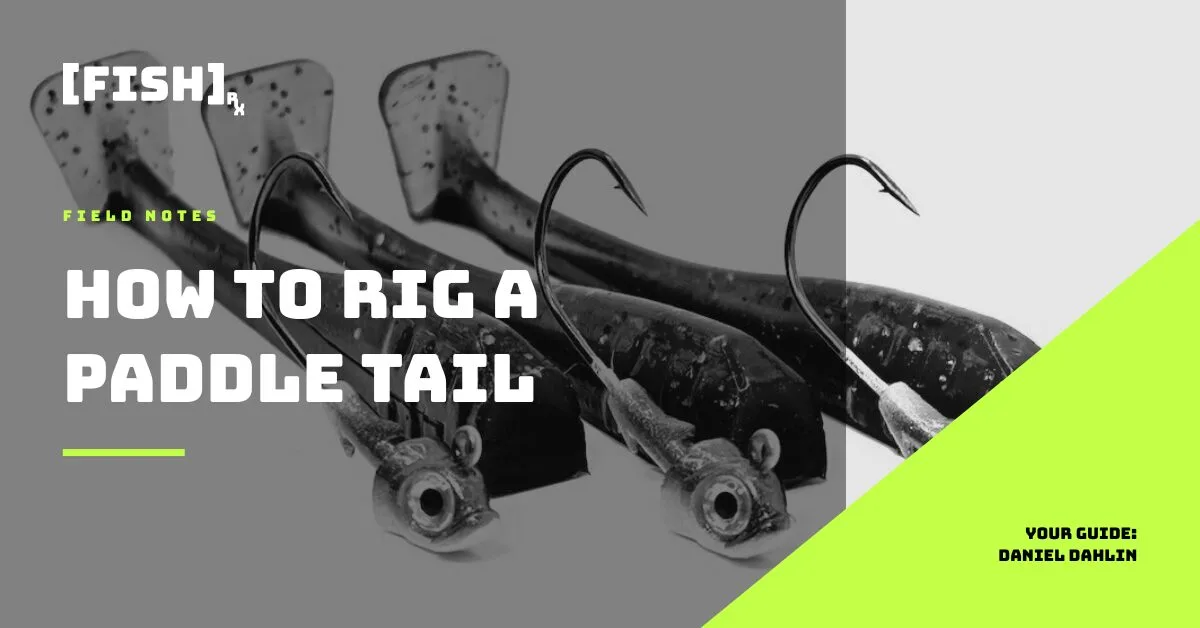
Knowing how to rig a paddle tail properly makes a bigger difference than most people think. Throw it out and slow roll it back and you’ll catch fish — but if you’re fishing the back bays and harbors around LA — structure-heavy water with current, finicky fish, and a lot of angling pressure — the setup details start to matter more than you’d expect.
The hook length, the weight, the way the bait sits on the head: each of those things affects how the paddle tail moves in the water, and movement is what gets bit. Here’s how to rig a paddle tail for SoCal inshore conditions, and why each decision makes a difference.
Shorter shank, more tail action … here’s why that matters
Industry standard for a saltwater lead head is a 3/0 straight-shanked hook. You’ll find it on most heads at the shop, and it works fine. But for the 3.5″ paddle tail, I prefer a 2/0 — or even a 1/0 if you can find it.
The shank is a little shorter, which moves the hook’s hinge point slightly forward into the bait. That gives the tail more freedom to kick. More kick means more action, and more action means more bites. When you’re fishing a bait this size, getting bit is the whole game.
A 3.5″ paddle tail is small enough that just about anything in SoCal waters can get it fully in its mouth: calicos, sand bass, spotties, even a 4″ fish will eat it clean. I’ve seen it. There’s no reason to put a giant hook in a small bait when the smaller hook is getting you more action and drawing the fish in.
For the 4.5″, same thinking applies — a 2/0 works there too. For the 5.5″, the logic flips. Bigger bait means more short bites, fish running it down without fully connecting. Go a little longer on the shank so a fish that hits the rear of the bait still gets the hook.
One thing to watch regardless of size: EWG hooks on swing heads come stock on a lot of popular setups right now. They’ll catch fish. Just make sure the bait folds enough to expose the hook shank — that matters more than hook size. If the bait doesn’t fold, you’re missing fish.
The difference between a 2/0 and a 3/0 is not huge. But a slightly shorter shank can be enough difference in action to get you more bites. Half the battle is how do I get more bites.
Jig head weight: start at half ounce, then read the water
Half ounce is my actual starting point for most MDR conditions. From there, I adjust based on tide and depth — not habit.
High tide, you’re fishing more water. Start at half ounce and work up if needed. Outgoing or low tide, start lighter and work down — the water’s shallower and the fish are tighter to structure. Some places you already know: if you’re fishing 50 feet of water with current pushing through, just start with a one ounce head. No reason to figure it out the slow way.
Lately I’ve been fishing slower, which means I’m reaching for 3/8 oz or even 1/4 oz more often. The goal is to slow the bait down and hang it in the strike zone — that pause on the fall, that extra beat before the bait drops again, has been getting bit. Lighter heads give you more of that.
Current is something you can use too, not just fight. Cast above your spot and let the drift carry the bait into position. More natural presentation, more time in the zone.
Which head to use: swim jig head, roll head, and scrounger
Swim jig head — the starting point
A standard swim jig head is versatile. You can cast and retrieve it, jig it up and down, hop it, bounce it off the bottom. It’s balanced, with the hook exiting the middle of the weight. Most of what you’ll find at the shop falls into this category. War Baits and Viking Heads both make solid options with weedless variants. The weed guard matters when you’re fishing close to dock structure and pylons.
Roll head — for slowing down in tight spots
The roll head looks similar to a ball head but the hook exits from the bottom of the weight, making it top-heavy. That changes everything about how it moves. When you jig it, instead of a straight up-and-down motion, the top-heavy weight wobbles side to side on the drop. You get a ton of action in a very short range.
That makes it ideal for spots where you don’t have long casting lanes — small flips and pitches into holes, tight quarters between pylons. You get more action with less retrieve. My preference lately has been roll head over standard ball head specifically because it helps me slow down while still giving the bait something to do.
Think of it as a speed spectrum: roll head is painstakingly slow to slow. Scrounger is slow to fast. Chatterbait is medium-fast to fast. Each has its window, and knowing which one fits the day is part of reading the conditions.
Scrounger — when you need wobble at speed
The scrounger has a bill that creates a side-to-side wobble on the retrieve — similar feel to a chatterbait but you can fish it across a wider speed range. The bill also wants to push the bait up, which is why I’ll go heavier on the scrounger head than I would on a standard swim jig head. Half ounce is usually right to keep it tracking in the zone.
Hook-to-bait ratio matters more than weight as you scale up
When you move from the 3.5″ to the 4.5″ or 5.5″, the variable that matters most isn’t weight — it’s hook fit. Big lead heads often come with hooks that are too large for a 4.5″ bait. You can force it on, but a hook that’s too big dampens the tail action. You’re back to the same problem.
There are also assist hook style setups — heads with no hook built in, where you rig a separate hook. That keeps the entire bait free to move with maximum action. Worth knowing about if you’re going deep on the 5.5″ or experimenting with bigger presentations.
One practical trick: if you’re getting short bites on the 5.5″ — fish hitting it but not connecting — try cutting it down. Trim an inch off and you have a 4.5″ profile with the 5.5″ tail kick. The tail action comes from the tail itself, not the full length of the bait.
Rigging it right: measure, mark, then swim it
Before you thread the paddle tail onto the head, hold the jig head up against the bait and gauge where the hook shank is going to come out. Put your finger there as a reference point. You can rough up a small notch at that spot — when you thread the bait on, pop the hook out of that notch and it’ll line up straight every time.
If the nose isn’t flat, trim it. Bite off a small piece or use scissors to get a flush connection between bait and head. A crooked bait spins instead of swims.
Then swim it before you cast. Lower the bait into the water next to the boat, float tube, or dock and watch what it does. This isn’t just a first-time thing — every time out, every new bait. Swimming your baits teaches you what action they have: which one has a tighter kick, which one wobbles more, which one’s running slightly off. When one bait gets bit and another doesn’t, you’ll start to know why.
Fixed jig head or weedless — fish the structure you’re in
Nose hooking isn’t really a paddle tail thing. The real question is when to use a fixed jig head versus a weedless setup.
Weedless on a scale: a weed guard on a jig head gives you some protection but it’s not fully weedless. A belly weight with an exposed EWG hook is more weedless. That matters when you’re in kelp — a lot of people burn paddle tails through kelp stringers and a truly weedless setup is what makes that work. You can also Texas rig, use a GK rig, or Tokyo rig with an EWG hook for flipping and pitching into heavy cover.
Around docks, pylons, and rocks, a weed guard helps. It won’t prevent every snag but it saves gear. Fishing gear is expensive and SoCal harbor structure is aggressive. In open water, you don’t need it. Let the structure dictate the call.
Color: start natural, then keep switching until something works
The logic is the same as on the slug. Start with baitfish colors and adjust from there. In any harbor I’m fishing consistently, I know there are fish. If they’re not biting, the question is why — is it color, profile, speed, cadence? Color is one variable of many.
Natural baitfish colors to start with: Chovie, Lavender Shad, Cosmic Shad, Wounded Soldier, Smelt, Lizardfish, Watermelon Pearl. These match what’s in the water most of the time and give the fish something familiar.
When naturals aren’t working, go weird. Sour Smelt, Sour Watermelon, Arizona Green Tea. Sometimes fish are bored with what they’ve been seeing all day. A burrito swims by when they’ve been staring at cheeseburgers all month — that’s the bite. High visibility and novelty can both trigger fish that won’t touch a natural presentation.
One color that shouldn’t work but does: nuclear apple. Chartreuse body, black tail. Bright, aggressive, kind of gross looking. I pulled the concept from a glide bait I saw and poured it on the paddle tail. It gets bit and I can’t fully explain why. Might be territorial. Might just be different enough. Either way, it’s in the rotation.
One detail specific to the paddle tail: a slight white belly. Pour the bait hot and let it blend in. It gives the profile a little more baitfish realism in clear water without changing the top color.
Retrieve: bottom contact first, everything else second
Before you think about cadence, get your bait on the bottom. These fish are coming off the bottom or sitting in structure just above it. If your paddle tail isn’t touching bottom or tracking near it, you’re not fishing effectively — regardless of retrieve style.
From there, let the fish tell you the cadence. One is luck, two is coincidence, three is a pattern. Cast, let it hit bottom, straight retrieve — try it. Not getting bit? Wind faster. Wind slower. Pause it. Hop it. Pop it. Dead stick it. Every change gives you information. What worked yesterday might not work today, and the only way to find the pattern is to fish through it.
Single jig head vs. MDR C-rig or A-rig
On a single jig head, you have more freedom. You can be creative — hop it, pendulum swing it in from above, scoot it on the bottom to kick up sand plumes, dead stick it between casts, open the bail and let it drop again after a fast burn. More options because you have less to tangle.
On the MDR C-rig or A-rig, the multi-bait setup already has a lot happening. Focus on keeping it near the bottom on a consistent retrieve. You can add jerkbait-style pumps — wind, wind, pump — which makes the bait ball look erratic and triggers reaction bites. But mostly it’s about that steady consistent movement.
Flipping and pitching pylons
When you’re flipping and pitching pylons, you’re not really doing a traditional retrieve. Pitch it in as close to the pylon as possible, let it hit the bottom, pop it twice, let it settle again. Quick, methodical, repetitive. This is where a heavier weight and more intentional action is the move — you’re covering structure fast, not slow rolling through open water. Spotted bay bass are the primary target around dock structure in the back bays — the spotted bay bass guide covers how to work marina structure specifically.
Putting it together
For most MDR and SoCal harbor situations: start with a half ounce [FISH]rx Paddle Tail on a quality lead head, 2/0 or 1/0 hook for the 3.5″, adjust weight for tide and depth, natural color first, bottom contact always. Measure before you rig, mark the hook exit point, swim it before the first cast.
That’s the starting point. Everything else you figure out by fishing.
Key takeaways
- A 2/0 or 1/0 hook on a 3.5″ paddle tail gives the bait more tail action than a standard 3/0 — more action means more bites, and on a bait this small you don’t need a bigger hook to land fish.
- Start at half ounce and adjust for tide: heavier on high tide and deep water, lighter on outgoing tide and when you want the bait to hang on the fall.
- Bottom contact is the baseline retrieve. Cadence is something you figure out by fishing the day — one fish is luck, two is coincidence, three is a pattern.
- In clear water, start with natural baitfish colors. When naturals stop working, go weird — the novelty can be exactly what triggers a fish that’s seen everything else.
Ep. 116 of Time on the Water covers how I rotated through presentations — including the paddle tail — during the Spotty Bowl. Real session, real decisions.
Frequently asked questions
What jig head weight should I use for a paddle tail swimbait in SoCal harbors?
Start at half ounce for most conditions and adjust from there. High tide or deep water with current, go heavier — sometimes a full ounce if you’re fishing 50+ feet. Outgoing or low tide, work down to 3/8 or quarter ounce. Lighter weights give the bait more hang time on the fall, which has been getting bit lately in the back bays.
What hook size is best for the 3.5″ paddle tail?
A 2/0 or 1/0 straight-shanked hook gives the 3.5″ paddle tail more tail action than the standard 3/0. The shorter shank moves the hinge point back, freeing the tail to kick more. For the 5.5″, go a little longer — short bites are more common on bigger baits and the extra shank length helps with hookup ratio on fish that hit the rear of the bait.
What’s the difference between the roll head and a standard ball head?
The roll head has the hook exiting from the bottom of the weight, making it top-heavy. When you jig it, it wobbles side to side instead of going straight up and down. That gives you more action in less distance — ideal for short flips into tight spots. The ball head is more versatile across retrieve styles. The roll head is specifically designed to maximize action while slowing the bait down.
When should I use a weedless setup vs. a fixed jig head for paddle tail fishing? head and a standard ball head?
Let the structure decide. Kelp and heavy cover call for a truly weedless setup — a belly weight or Texas-rigged EWG is more weedless than a jig head with a weed guard. Around docks and pylons, a weed guard helps but isn’t mandatory. Open water, you don’t need it. The weed guard on a jig head gives you some protection but nothing is fully weedless.
Does color matter differently on a paddle tail vs. a slug?
Not much. Start with natural baitfish colors — Chovie, Lavender Shad, Cosmic Shad, Smelt — and switch until something works. One detail specific to the paddle tail: a slight white belly blended in hot adds baitfish realism in clear water without changing the top color. When naturals stop producing, go for novelty — bright, unusual colors can trigger fish that have seen too much of the standard presentation. For the full color framework including conditions, species, and seasonal shifts, the soft plastic colors guide covers it all.
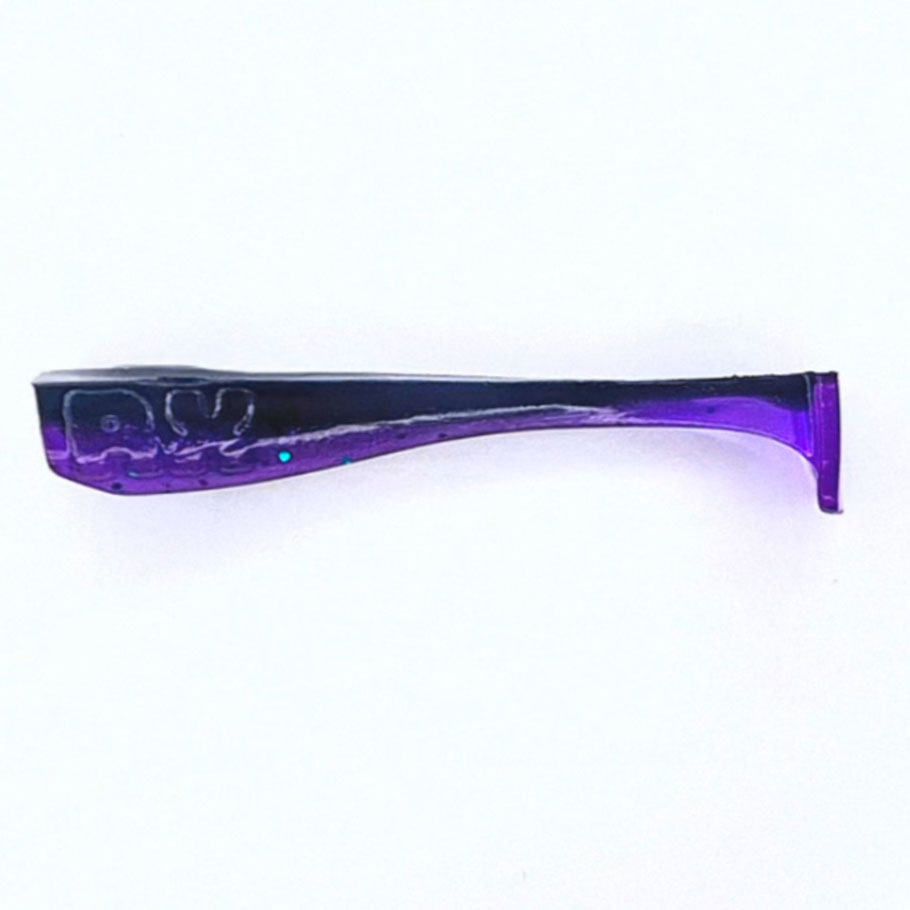
RX Paddle Tail
The [FISH]rx Paddle Tail is available in 3.5″, 4.5″, and 5.5″. Handcrafted in Los Angeles, tested in SoCal’s back bays.