![[FISH]rx Logo in Black](https://fish-rx.com/wp-content/uploads/2025/07/FRXLOGO-BLK.png)
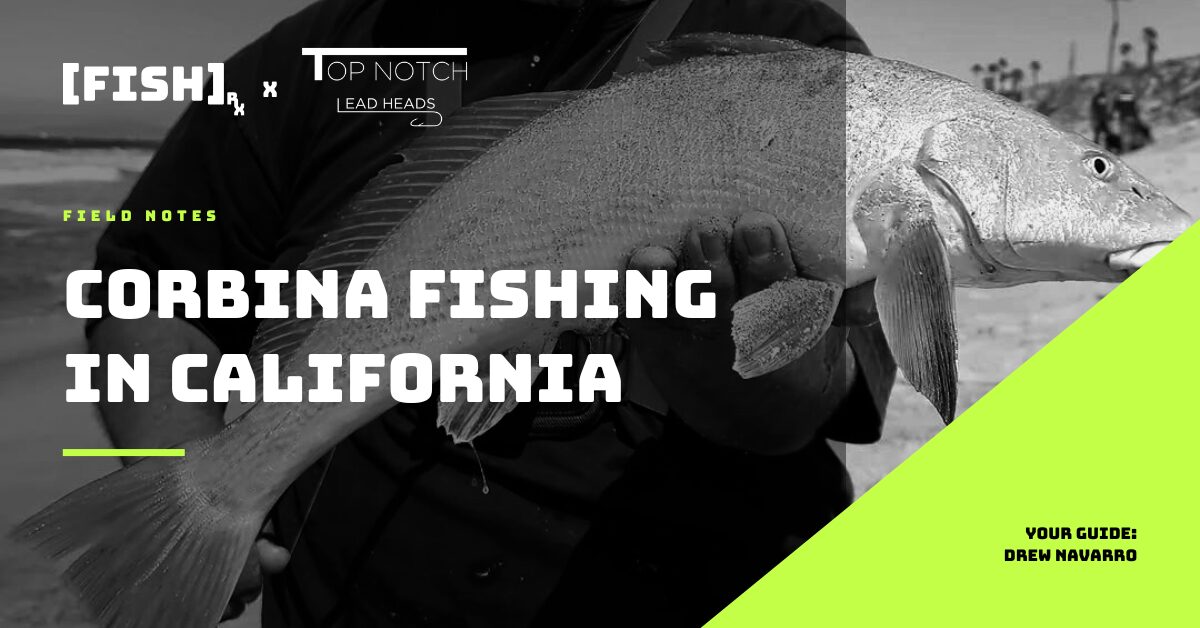
I’ve been on top of corbina for a whole month and caught two. That tells you exactly what corbina fishing SoCal is. These are not fish you figure out in a session. They are not fish you luck into on artificials. If you catch one on a jig or a soft plastic, you earned it.
I started targeting corbina because I got tired of watching them swim past my halibut baits in a foot of water and not caring. I grew up fishing light line for halibut along Orange County beaches, and I saw corbina all the time. One day I watched a guy creep along the sand with a trout rod and four-pound test, throw a sand crab in front of a fish, and get bit. I wanted that. I went out the next week with a Carolina rig and live sand crabs, and I caught a few. Then I made the switch to artificials only, and that’s when corbina fishing got difficult in all the right ways.
I haven’t used bait on the beach since. I use my own sand crab jigs and surf heads. It has cost me fish. It has also taught me more about this species than anything else I’ve tried.
Where Do Corbina Actually Hold, and How Do You Pick a Beach?
Most of the advice you’ll hear about reading a surf beach goes like this: walk until you find nervous water, look for troughs and holes, cover as much sand as possible. That’s not wrong. But it took me years to figure out that corbina use the tide like an escalator, and once I understood that, I stopped walking as much.
Corbina are not random. They slide up and down the beach with the current and the tide. Some fish hold in troughs (narrow depressions in the sand just off the surf line that can drop from ankle-deep to three feet in the span of a step). Those depressions form from hard wave breaks and they give corbina a place to shelter, conserve energy, and wait for the surge to push food their way. When structure is present, you can see it: the foam disperses differently over deeper water, and sometimes you can physically see the drop-off.
The troughs are not always there. Swells move structure. A good trough that held fish for two weeks can be flattened overnight. That does not mean the beach is done — it means you adapt.
What I Actually Look For
When I show up to a beach, I go straight to the water and I look. If there’s a visible trough or hole within reach, I set up on it. If there’s nothing and no corbina sliding through shallow, I put on a surf head and start blind-casting behind the breaks of each incoming set. Corbina run down the beach with the tide. They will come to you if you are patient and in the right zone.
The hardest part of picking a beach is that two beaches can look exactly the same and hold completely different numbers of fish. One stretch will have loaded sand crab beds with no structure. Another will have perfect troughs with no crabs. What you want is both. Corbina go where the food is. If the sand crabs are concentrated on a stretch with some trough structure to hold them in place, that beach is worth your time.
Sand crab beds tend to show at the high tide. That is the best time to observe them before they go underwater as the tide fills. Then you come back and work that water.
Fish have tails. They will find you if you are in the right zone. Stop walking and let the beach work.
Tide Timing
My preference is to arrive about an hour before the high and fish through an hour after. That gives me three to four hours of moving water with structure fully filled and corbina actively working the beach. I don’t love slack tide, but at the high you at least have fish holding in the filled structure, so I’ll take it.
Low tide is a different conversation. I have had some of my best incidental catches on outgoing tides, including two of the biggest spotfin I’ve ever seen. My honest read is that the low can be productive depending on the beach, but I haven’t fished it enough in the stretches I know to call it reliable. I keep coming back to the high because I know what the structure looks like when it’s full. That might be my own bias. Don’t let my preference cost you fish. If you have the time, try the outgoing too.
What Does a Corbina Eat, and What Does That Tell You About the Bait?
Corbina have three main food sources: sand crabs, ghost shrimp, and mussels or bean clams. You can match the first two with artificials. The clams I haven’t cracked yet.
The reason presentation is so specific to this fish comes down to the mouth. Corbina are built like a carp. The mouth is underslung, pointing down and forward, designed to suck and root from the sand. They are not ambush predators racing up to grab a reaction bait. They root, they siphon, and they pick.
When a surge dislodges sand crabs from the bed, the corbina are there to pick them up — fast, in a short window, and then they’re back down in the trough waiting for the next push. That biological fact tells you everything about how to fish for them.
Sand Crab Profile: Small, Flat, and On the Bottom
For a sand crab imitation, I want a bait that is roughly 1.75 to 2.5 inches, with a flat profile that settles naturally on the sand. Z-Man Crustyz, Battle Star Perch Candy, and similar compact flat plastics work well. Pair them with a lightweight jig head — I use my own Trapper Heads, available at Tackle Cave USA — and set them up to scurry along the bottom with tiny ticks. Go heavier in current or wind, up to 1/2 oz. Drop to 1/4 oz when fish are close and visible.
Cast behind the incoming set, let the bait hit bottom, and work it back with short, erratic ticks that mimic a crab trying to dig back into the sand after being dislodged. I cannot overstate how little action you need. Tiny ticks. A lot of my bites have come from a bait that was basically sitting there.
The corbina sees it, positions over it, and loads the rod. Don’t set the hook the second you feel anything. Wait for that load. Their mouths require them to get the angle right before they commit, and a premature hookset will pull the bait away clean.
Wait for the rod to load. Their mouths need a moment to get the angle right, and if you set early, you’ll pull it away clean every time.
Ghost Shrimp Profile: Slender and Castable
For ghost shrimp, I go to a 3 to 3.5 inch slender profile. A Z-Man Micro Goat is a good example. The bait is more aerodynamic than a crab profile, which means I can cast further with lighter line. The retrieve has a bit more hop to it, more like a crustacean tumbling through the water column rather than crawling on the sand.
In terms of color, darker earthier tones tend to be my starting point: motor oil, green pumpkin, and gray with fine sparkle. Sand crabs are often a dirty gray, especially the hard-shelled ones. But there is something to orange and pink as well, particularly on the belly of the jig head. A lot of the best surf head colors I know have a bright orange or pink underside, imitating the egg sac on a female crab.
I’ve caught corbina on colors I didn’t expect. My honest take: contour matters more than color. They are looking for the right shape and profile first. Color is secondary, but an orange-belly jig head on a gray or tan body covers both bases.
Hooks Matter More Than People Think
In the surf, your bait is getting sandblasted. Inferior hooks dull out fast. I use Owner hooks specifically because they hold their edge through a session in a way that most hooks don’t. The hook point diameter matters too. Corbina have a tough, gummy mouth that is notoriously good at rejecting baits. A needle-sharp small-diameter hook sticks far better than a thicker one that can’t penetrate cleanly. Don’t cut corners on the hook. Everything else can be basic, but the hook is where you win or lose the fish.
When Is the Bite Window, and How Do You Know When to Cast?
This is the part that took me the longest to figure out, and I’m not sure anyone told me directly. I had to watch it happen.
Corbina that are actively sliding through the wash are not always feeding. You can cast at a fish that swims right up to your bait and turns away. You can do that twenty times on the same day and not understand why. What I eventually saw was this: when a surge pushes significantly higher than the surrounding sets — when the water climbs up the sand burn and the corbina runs up with it — that is the moment they feed. They ride the surge up the crab bed, the crabs get flushed out of the sand, and the fish eat on the way up.
That is the window. It is short. It is maybe a few seconds per surge. Finding that specific surge in a given set of waves is what separates catching corbina on artificials from just casting at them.
How I Apply It Now
When I see corbina sliding through the trough or working the wash, I do not immediately cast. I watch. I back up out of the water and get high and dry on the sand. I wait for a bigger surge to build. The moment I see the water start to push higher than the previous sets, I put my cast in front of where the fish was and let the bait sit. The surge rolls up. The bait moves naturally with the water. If a corbina is there, it eats on that push.
I’ve done this twice with it working both times: once when I finally figured it out, and once on camera. I am not claiming I’ve got it locked down. I’m saying that those two catches changed how I see this entire fishery.
On days when I cannot see fish, I blind-cast a surf head behind the breaks and cover water. I’ve caught corbina that way too. But sight fishing with the surge as your timing cue is the approach that I believe in most. The fly fishing anglers who have been doing this longer than me operate the same way. They walk for long stretches, stop, watch, and cast at exactly the right moment. The fly most of them throw is a Surfin’ Merkin, and they are not stripping it hard. They dead-drift it and wait. The patience is the technique.
The surge is the window. That is it. Wait for the bigger push, put the bait in front of the fish, and let the water do the work.
Staying Out of the Water
One thing I cannot stress enough: get out of the water when you’re fishing for corbina in the wash. If you are standing at the water’s edge, the surge you want to cast off is going right past your feet. You need to see it coming and time the cast before it gets to you, not from inside it. I have had corbina do U-turns around my feet when I was wading. They are that spooky. Back up. The fish will come to you.
What Gear Do You Actually Need?
You do not need a specialized surf rod for this. I use an 8-foot Fishing Syndicate in a 2–6 lb rating, matched with a Shimano Stradic CI4 in a 1000 size. I run 4 lb straight mono or 10 lb braid to a 6 lb fluorocarbon top shot. That’s my setup when I’m dialed in.
If you are starting out, a 7 to 9 foot trout rod or a drop-shot rod rated for 6 lb line will work. Keep the reel in the 1000 to 2000 size range. Six-pound straight mono or fluorocarbon is a solid starting line. Don’t go heavier than 8 lb — you lose too much castability and the line becomes visible enough to matter in clear surf water.
The bycatch alone makes this worth doing. When you’re targeting corbina in the surf on a sand crab or ghost shrimp imitation, you are fishing for everything. Surfperch, yellowfin croaker, leopard sharks, bat rays, shovelnose guitarfish, and the occasional spotted bay bass pushing through the wash. They all eat the same profile. Some outings you’ll go a full tide cycle without a corbina and still have a great session.
There is no minimum length or bag limit for California corbina under current CDFW regulations. They fall under the 20-fish general bag limit, 10 corbina maximum. But this is a fishery worth practicing catch and release, especially on artificials. The effort it takes to catch one should make you want to put it back.
What Corbina Fishing SoCal Actually Looks Like
I cast at a minimum of 30 to 40 corbina every time I went out last season. I caught two. That is not a bad run by this fishery’s standards. It is just what corbina fishing SoCal is on artificials.
The people who are genuinely good at this are few, and they do not give up much. The fly anglers I watch on the beach are patient in a way that is almost meditative. They walk, they watch, they wait for the right fish in the right position, and they make one perfect cast. I am learning to do the same thing. Most sessions I go home having cast at fish I did not catch and having learned something I did not know.
That is the part nobody tells you when you see a corbina slide through the wash and think: I want one of those.
Key takeaways
- The surge is the bite window. When a larger-than-average push of water climbs the sand burn, corbina run up to feed. Time your cast to that surge, not to the fish’s position between sets.
- Get out of the water. Standing at the surf’s edge puts you inside the bite window. Back up onto dry sand so the surge passes in front of you, not through you.
- Match the mouth. Corbina root from the bottom like a carp. Use a 1.75 to 2.5 inch flat profile for sand crabs or a 3 to 3.5 inch slender profile for ghost shrimp, dead-sticked with tiny ticks on the bottom.
- Wait for the rod to load before setting the hook. Corbina’s gummy mouth needs a moment to get the angle right, and a premature hookset pulls the bait away clean every time.
Frequently asked questions
A few more questions on corbina fishing in the SoCal surf:
What is the best time of year to target corbina in Southern California?
June through August is the peak window. Sand crab abundance is at its highest during those months, and corbina follow the food. They’re present year-round and will eat a crab imitation in any season, but if you’re trying to find concentrations of fish working the wash, summer is when it happens.
Can you catch corbina on artificial lures?
Yes, but it is one of the more difficult things you can do in SoCal surf fishing. Corbina are extremely selective and spook easily. The most effective artificials are compact sand crab profiles in the 1.75 to 2.5 inch range, fished on a lightweight jig head with minimal action. Ghost shrimp imitators in the 3 to 3.5 inch range also work. Expect to cast at a lot of fish before one commits.
What tide is best for corbina fishing in the surf?
An hour before to an hour after the high tide is a reliable starting window. Structure — the troughs and depressions corbina use as feeding lanes — is fully filled at the high, and fish are actively working the wash. Outgoing tides can also produce, especially on beaches with defined structure. Avoid low tide unless you know the beach well; there’s often too little water to keep fish in the zone.
Is there a size limit or bag limit for corbina in California?
California corbina have no minimum size limit and are open year-round. The bag limit is 10 fish as part of the 20-fish general daily bag limit under current CDFW regulations. That said, catching corbina on artificials is hard enough that most anglers practicing catch and release is the norm rather than the exception.
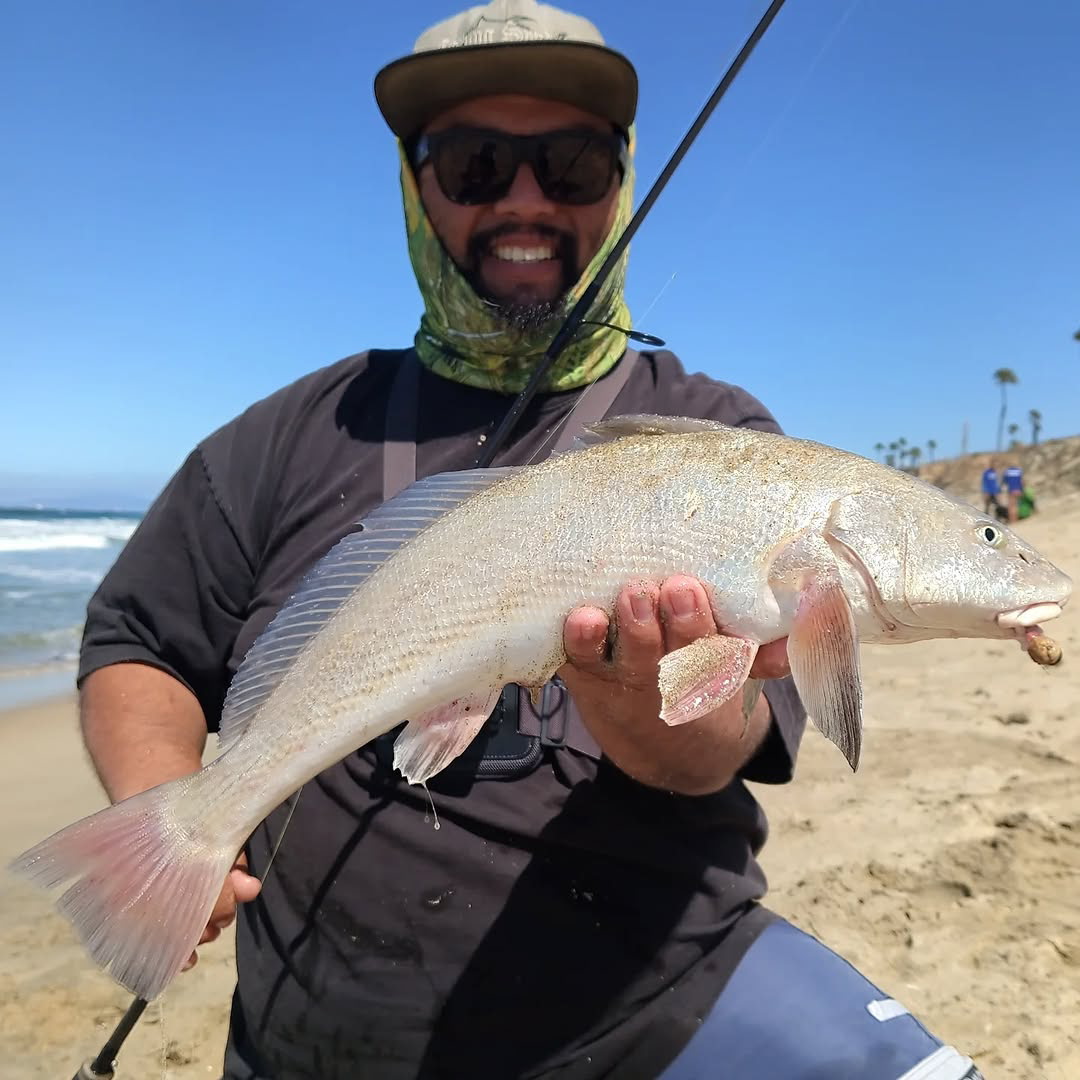
Drew’s Gear
Drew’s Top Notch Leadheads sand crab jigs and surf heads are the tools he fishes throughout this guide. He broke down the full system — head weights, retrieve cadence, and plastic selection — on Ep. 128 of Time On The Water. Both products are handbuilt and available by pre-order in small batches. Check @topnotch_leadheads on Instagram for drop dates or visit Tackle Cave USA when they’re in stock.
If you’re targeting corbina for the first time and Drew’s product isn’t available, start with a compact flat-profile soft plastic in the 2 to 2.5 inch range on the lightest jig head you can cast. The profile matters more than the brand. The fish will tell you the rest.