![[FISH]rx Logo in Black](https://fish-rx.com/wp-content/uploads/2025/07/FRXLOGO-BLK.png)
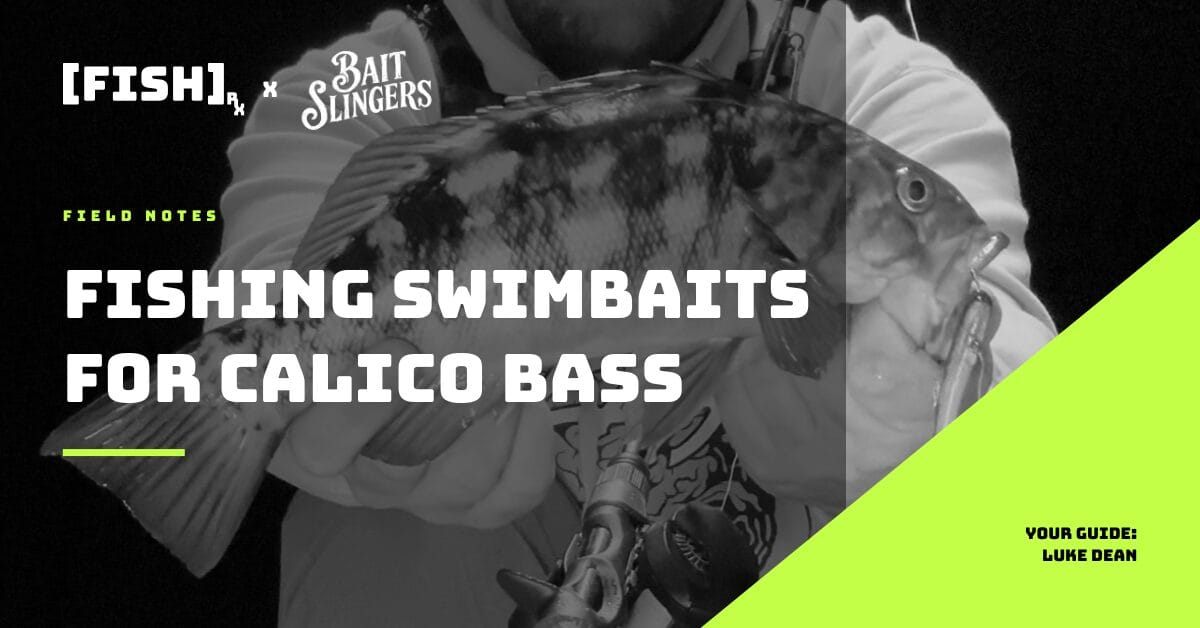
It was Christmas night — conditions lined up just right, my wife and I got on the water, and in thirty minutes I landed a 4-pounder and a 5-pounder. That’s calico bass fishing in SoCal. It doesn’t stop in winter, it doesn’t follow a calendar, and it doesn’t require perfect conditions. I’ve been running Artemis Charters on the Long Beach breakwall for years and I’ve had to go out on days I wouldn’t have chosen — and a lot of those days were better than I expected.
My personal best calico is 9.5 pounds. Calico fight hard, have an all year round fishery, and you can catch them on fun baits. That is the whole conversation about why calico are worth specifically targeting.
People assume calico are an aggressive, easy bite. Sometimes they are … they’ll absolutely demolish a swimbait. But I’ve also had nights where they’re picking up a creature bait so softly they don’t even realize they have it in their mouth yet. You set the hook fast on those or they spit it. They’re not always what you expect, which is part of what makes them worth chasing year-round.
Where calico bass hold in SoCal
Calico bass — technically a kelp bass, not a true bass — are the dominant inshore structure species on the California coast. Rocks, reefs, rip-rap, breakwalls, kelp — anything that could be covered is where they’re going to be. I’ve caught them in two feet of water and I’ve caught them at 90 feet. From Mexico to Ventura. They’re not hard to find if you’re fishing structure.
Open water calico happen. I’ve pulled up on boils in PV before and found calico blowing up bait in the middle of nowhere. But that’s the exception. Don’t plan your day around it. Plan your day around structure, and occasionally the open water bite will find you.
Fishing kelp for calico
Kelp is the primary calico environment in SoCal and the one most people are fishing when they specifically target them. Think of kelp like a forest: structure from the seafloor all the way to the surface. That means calico can be holding anywhere in that water column on a given day, and not enough people are fishing the low end of it.
Lanes and positioning
When the kelp is laying down from wind or current, it creates lanes — open channels between the kelp where you can cast and work a bait without immediately fouling. Those are the shots I prefer. Cast down the lane, work the bait back, let it move naturally with what’s in the water.
When the kelp is upright and thick, I’ll sometimes lift the trolling motor and drift through. If the fish are holding low near the stalks, I might even let the motor get stuck in the kelp to slow the drift down so I can pitch accurately. It sounds like a pain. It is. But that’s where the fish are on those days.
Outside edge versus inside canopy
The outside edge is easier to fish and more accessible. Most people are there. Inside the canopy is more work but sometimes that’s where they’re feeding. I don’t have a strong preference between the two … I go where the fish are on that day. If the outside edge isn’t producing, I’m going in.
What to throw in kelp
In kelp, I’m primarily on slugs, paddle tails, or flukes. I’ll fish creature-style baits too, but usually something like a dragon tail on a scrounger head rather than a pure bottom-contact setup. The kelp environment rewards baits that can swim through it without constantly fouling. A weedless setup is worth it here, and the line strength call matters more than most people account for. If you go too light chasing bites, you’re not getting fish out of thick kelp.
People go lighter thinking they’ll get more bites. Then they get that really good biting breakoff. You can’t pull a big calico out of heavy kelp on light leader. It doesn’t work.
The wall, rocky points, and rip-rap
Breakwalls are my home water. I run Artemis Charters out of the Long Beach breakwall — 8.5 miles of outside wall, another eight on the inside, oil rigs nearby. The same principles apply to any hard structure in SoCal, but the wall is where I’ve put the most time.
Rocky points get a lot of credit from anglers. I think people give them too much. We’ve had good bites on rocky points, but it’s rare that the points are where the fish are stacked. More often we’ll drive right past a point that has boats on it, fish the broader structure, and cut twice as many fish. Focus on the grand scheme of structure, not just the obvious points.
Top, middle, bottom applies everywhere, not just kelp. On any hard structure, calico can be sitting in any part of the water column. The fish finder helps when you can read it, but honestly on complex structure you often can’t see the fish on the screen anyway. The question isn’t whether they’re there. They’re there. The question is what they want.
Presentation on hard structure
My three profiles on hard structure are creature baits, paddle tails, and slugs or flukes. I rotate through all three because the fish are going to tell me which profile they’re on. There’s no formula for it. I pick one based on feel, get a few casts in, and adjust from there.
At the wall specifically, the retrieve is almost always slow. There are nights they want it fast, but those are the exception. Default to slow, then speed up if they’re not responding. Kelp is more moderate as a starting point, but the same principle applies … they’ll tell you the right speed if you’re paying attention.
Start at 3/4 ounce and let the fish tell you the rest
For calico I almost always start at 3/4 ounce. I will rarely target calico with significantly more or less than that. It’s just where I fish most consistently for them and it’s become my baseline.
Starting size is around 5 to 5.5 inches. From there I adjust based on whether I’m getting bit and whether I’m getting short strikes. Short strikes usually mean go smaller. No bites usually mean try both directions and see what changes. The 4-inch presentation has become more of my go-to than it used to be … there’s less bigger fin bait in the water than there used to be, and smaller profile baits have been more productive.
A paddle tail is always tied on. I don’t think there’s a condition where a paddle tail is the wrong call for calico. Even when they want a creature presentation, you can dead stick a paddle tail and get some craw-like action out of it. It’s the most versatile bait in the rotation.
What color works for calico bass
If I had to break it down to four colors for calico, I want an orange, a brown, a red, and something bright … chartreuse over white for me personally, though some people love a white bait. That’s a starting framework, not a rulebook.
The honest answer is they’ll tell you what they want. I’ve had nights where the only thing that worked was bubblegum pink, and as soon as we ran through every bubblegum pink bait on the boat the bite died. That’s a color I keep on hand specifically because of that night, even though it rarely works. You need variety.
One thing that matters more than color selection is looking at your bait in the water before you commit to it. Sometimes a color that normally looks great looks too bright or too dull in the current conditions. Drop it in and actually look at it. That five-second check has saved a lot of sessions.
Custom [FISH]rx colors for calico
I worked with [FISH]rx on a few colorways built around what I was looking for in the water. Company Colors came from wanting a brown bait with a really pronounced black tail — something I hadn’t seen done the way I wanted it. That one has been consistent.
Purple Sticky Punch came from combining two colors I knew worked on their own but had never seen together. Both of those are on Bait Slingers if you want to see them in context.
For a full breakdown of how to read water clarity and conditions for color selection, the soft plastic colors guide covers it.
Does season change the calico bite?
Less than people think. Calico bass are a 12-month fishery in SoCal. The biggest mistake I see is anglers who pack it in when it gets cold because they assume the bite is over. It isn’t. If anything, winter is when I’ve seen the quality go up. The numbers might slow in some spots, but the average size of what you’re catching gets better. We’ve had slowest-night-of-the-month numbers at 34 fish in winter. We’ve had nights in the 50s for three anglers. It’s not a dead season.
The one time I’d say season creates a recognizable pattern is around the spawn. When you see calico with orange war paint on their face, that’s a spawning fish … and they’re fired up. I’ve seen the spawn happen in spring and in fall. It doesn’t follow a strict calendar, it follows water temperature and other factors we can’t always predict. But when you find spawning calico, they bite.
Beyond that, my honest advice is stop focusing on season and start focusing on what the fish are telling you that day. Color, depth, speed, presentation … they’ll communicate all of it if you’re paying attention and willing to adjust.
If you’re focusing on season, you’re already overlooking what the fish is telling you. We know calico are going to eat. The question is what do they want right now.
When the bite slows, change everything
The most reliable sign that calico are actively feeding is birds. Diving birds over kelp or structure means fish are pushing bait. Even birds sitting on the water near a kelp edge are worth a cast. That’s my first indicator before I even make a presentation.
When the bite goes slow, I change everything. Spots, presentation, cadence, color, depth. On a slow charter night I might hit twelve or more spots looking for a zone where they’re feeding. That’s not failure, that’s fishing. The fish are there. They’re always somewhere on structure. The game is finding where and what they want to eat that day.
One thing I’ve learned running charters is that conditions don’t predict the bite the way you’d think. I’ve had nights that looked perfect on paper that were mediocre. I’ve had nights I wouldn’t have chosen, picked by a client based on their schedule, that were genuinely great. At some point I stopped trying to predict it and started just going out and figuring it out on the water.
Key takeaways
- A paddle tail is always tied on. There’s no calico condition where it’s the wrong call, and it’s versatile enough to cover kelp, hard structure, and open water all in one session.
- Line strength matters more than most people account for in kelp. Going too light to chase bites means not landing the ones that actually matter.
- Calico bass are a year-round fishery. Winter is underrated and often produces bigger fish. Stop fishing seasonally and start listening to what the fish are telling you on the day.
Frequently asked questions
What size swimbait should I use for calico bass in SoCal?
Start around 5 to 5.5 inches and adjust from there. Short strikes usually mean go smaller. If you’re not getting bit at all, try both directions. The 4-inch profile has been producing well recently as bait sizes in the water have trended smaller. For the 6-inch and larger, short strikes become more common and you may need to bump down a size before you find the right fit for the day.
What’s the best color for calico bass?
Orange, brown, red, and a bright option like chartreuse are the four I’d want as a starting framework. Beyond that, variety matters more than any specific color. Look at your bait in the water — if it looks wrong for the conditions, it probably is. Calico will hyperfixate on specific colors when bait in the water is pushing a particular profile, so carrying a wide selection gives you the best chance of matching what they’re keyed on.
Is winter a good time to fish calico bass in Southern California?
Yes — and it’s underrated. The numbers might slow compared to peak season, but the quality often improves. Bigger fish come out more consistently in cold water. The assumption that calico stop biting in winter is wrong. If you’re willing to dress for it and put in the time, winter calico fishing in SoCal can be some of the best of the year.
![Bait Slingers x [FISH]rx – Purple Sticky Punch & Company Colors](https://fish-rx.com/wp-content/uploads/2026/04/Bait-Slingers-x-FISHrx-Purple-Sticky-Punch-Company-Colors.png)
Company Colors & Purple Sticky Punch
Custom [FISH]rx colorways designed by Bait Slingers for SoCal calico bass — a pronounced dark lateral line, black tail, and the purple and green combo that’s been producing at the wall and in the kelp. Available exclusively through Bait Slingers.