![[FISH]rx Logo in Black](https://fish-rx.com/wp-content/uploads/2025/07/FRXLOGO-BLK.png)
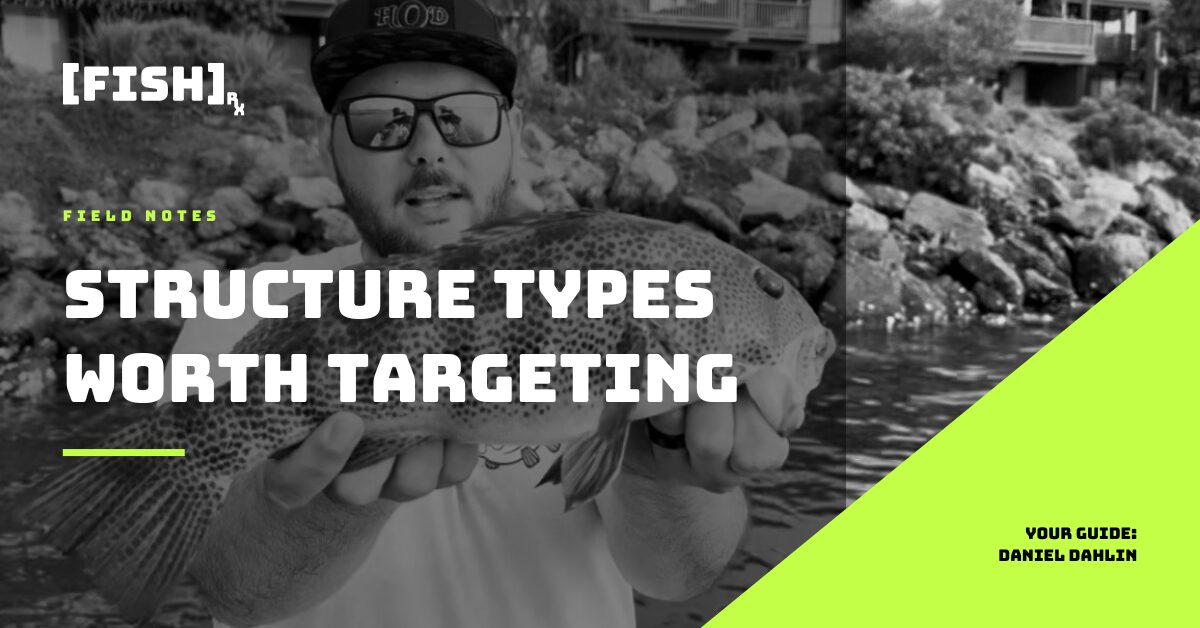
SoCal inshore structure is what holds the fish: spotted bay bass, calico, and sand bass aren’t scattered randomly across the water. They hold on specific types of structure for specific reasons: shade, current, ambush position, baitfish concentration. Once you understand what each structure type offers the fish, you stop guessing where to cast and start making decisions. That shift from random coverage to intentional presentation is what separates productive sessions from slow ones.
This guide covers the six structure types that consistently produce across SoCal’s harbors, back bays, and coastal edges. No specific spots. This applies to any harbor or back bay in the region. The fish hold the same way everywhere because the structure functions the same way everywhere. For how to work specific SoCal marina and jetty structure, see the urban structure guide.
1. Dock pylons and marina edges
The most available structure in any SoCal harbor and the most productive for spotted bay bass specifically. Pylons create shade, break current, and give bass a vertical ambush position. The fish hold in the shadow line under the dock facing into current, waiting for baitfish to come to them.
What makes a pylon section productive isn’t the pylons themselves. It’s the combination of current direction, shade angle, and baitfish presence. A pylon line with no current moving through it and no bait around it will be dead regardless of how good it looks. The same pylon line with tide pushing through on an incoming current and a pod of anchovy or smelt stacked against it is a completely different proposition.
Best presentations: drop shot with a 4-inch RX Slug fished along the edge, or a Skeleton Craw on a light drop shot fished vertically next to the pylon base. Cast parallel to the structure, not at it. The fish are sitting in the shadow line, not in the middle of the open water between pylons.
2. Rocky points and breakwalls
Rocky structure creates irregular bottom topography (holes, ledges, overhangs) that all our salty bass use as ambush positions. The current deflection off rocks also concentrates baitfish in predictable locations, which is why rocky points at the entrance to a harbor or bay are almost always worth a few casts.
The key word is irregular. A smooth concrete seawall holds fewer fish than a rocky edge with varied texture because there’s more ambush real estate. When you’re fishing a breakwall, you’re looking for sections with the most broken, uneven surface: corners, gaps, spots where the wall steps out or changes angle. Those transitions within the structure hold fish consistently.
Best presentations: crankbait trolled with bottom contact along the wall edge, or a bladed jig worked with a pop-and-pause cadence. In both cases the goal is contact with the rock surface. Deflections and ticks trigger bites that a clean retrieve through open water doesn’t.
3. Channel edges and depth transitions
The drop from shallow to deep water within a harbor or back bay creates a seam that bass use as a feeding lane. Baitfish moving with current stack up at these transitions, and bass stage just below the edge to intercept them.
Channel edges are harder to read visually than pylons or rocky structure because there’s nothing on the surface telling you where the drop is. You need to know the bottom contour, watch for subtle current differences on the surface, or pay attention to where baitfish are schooling and what’s sitting below them. When current is actively running through a channel, the edge where faster current meets slower water, the seam, is often the most productive twenty feet of the whole channel.
Best presentations: paddle tail or an MDR C-Rig worked along the edge, covering water efficiently at the right depth. Size up on profile when you’re searching a channel edge; a 4.5 or 5.5-inch RX Paddle Tail gets noticed from further away than a finesse bait and covers more water per cast.
4. Current breaks and eddies
Any place where current is deflected (a point, a piling, a dock corner, a moored boat) creates a low-pressure zone on the downstream side. Baitfish collect in these eddies to rest out of the current, and bass know it. This is one of the most reliable bite-triggering conditions in the entire SoCal inshore fishery when the tide is running.
The current break in the LA Harbors transcript was as direct as it gets: fish the distil on the surface where the glassy water meets the ripple, and you’ll find spotted bay bass and sand bass sitting right in that seam. That visual cue, a patch of glass in moving water, is something you can see from the surface and cast to precisely. When you see it, fish it.
Best presentations: anything that gets in the current break and stays there. A drop shot anchored just above the seam, a slow-rolled paddle tail working through the eddy, or a bladed jig fired into the current and swept back through the break naturally.
5. Kelp edges and open coastal structure
Calico bass specifically are a kelp fishery. They use the kelp canopy as cover, the stipes as ambush lanes, and the edge where kelp meets open water as a feeding zone. The outside edge of a kelp bed, where clear water transitions into the kelp, holds fish almost year-round and responds to a wide range of presentations.
Fishing the kelp edge requires working the transition zone. You want your bait tracking along the outer edge where calico are patrolling, and into the canopy. Yes, you’ll catch kelp but that’s where the calico live. Swimbaits and paddle tails worked parallel to the edges and through the kelp are the most effective approach.
This is the structure type with the least coverage in the current content library. Dedicated calico kelp fishing sessions are coming. The principle is the same as every other edge in this guide: fish the transition, not the middle.
6. Fuel docks and open harbor infrastructure
Fuel docks, launch ramps, and similar harbor infrastructure get overlooked because they’re functional rather than scenic. But a fuel dock with boats coming and going drops baitfish-attracting chum into the water continuously, creates shade, and gives bass a structure edge to hold on. The fish are there because the food is there.
Open harbor infrastructure also includes the edges of boat channels, mooring fields, and any vertical structure that breaks the otherwise featureless bottom of an open harbor. These aren’t glamorous spots but they consistently hold fish, especially in the middle of the day when more obvious structure has been pressured and the fish have moved off.
Best presentations: drop shot or slow-rolled slug worked along the edges of the infrastructure. This is a finesse situation: the fish are usually holding tight and have likely seen plenty of fast-moving presentations from passing boats and shore anglers.
Reading a new harbor for the first time
When you’re fishing a harbor or back bay you don’t know, the priority order is: find current, find structure, find bait. In that order. A section of pylon structure with no current and no bait is going to fish slower than open water with a good current break and baitfish stacked on it. Current activates the whole system. Fish where the water is moving first, then refine from there.
Don’t commit too long to any one section early in a session. Make a few casts, read the water, move efficiently. Once you’ve located fish, even one bite in a section, slow down and work that area methodically. You’ve confirmed the structure is holding. Now find out how many fish are in it.
If a spot doesn’t give you something in a few casts, that’s information. If you go back to the same spot two hours later expecting different results … that’s just hope. Move until you find fish. Then figure out why they’re there.
Key takeaways
- Fish hold on structure because of three things: shade, current break, and bait proximity. Any structure type that offers at least two of those three is worth serious time.
- Current activates structure. The same pylon section that’s dead on slack tide can turn on completely when the tide starts moving. Timing your session around moving water matters as much as where you fish.
- Fish the transitions. The productive zone is almost always the edge of a structure type: where kelp meets open water, where a channel drops off, where fast current meets the eddy. The middle of any structure type is less productive than its edge.
Frequently asked questions
Where do spotted bay bass hold in a SoCal harbor?
Spotted bay bass hold on vertical structure: dock pylons, piling edges, bridge supports, any place that creates shade and breaks current. They orient to the shadow line on the downstream side of structure, facing into the current and waiting for baitfish. In back bays, pylon lines on an incoming tide with baitfish present are the most reliable locations in the fishery.
What structure types hold calico bass in Southern California?
Calico bass are primarily a structure and kelp fishery. Rocky points, breakwalls, and the outer edges of kelp beds are the most productive zones. They use irregular rocky bottom as ambush cover and hold at depth transitions where baitfish concentrate. The edge of any kelp bed, where open water meets the canopy, holds calico bass consistently across seasons.
Do you need to know specific spots to catch bass in SoCal inshore?
No. Understanding structure types and how to read current is more valuable than knowing named spots. The same structural features: current breaks, depth transitions, vertical structure with shade, hold fish in every harbor and back bay in the region. An angler who can read water will find fish in any new location. An angler who only knows specific spots is stuck when conditions change or the fish move.
![[FISH]rx RX Skeleton Craw in Watermelon Blue, 3.25" — handcrafted soft plastic bait for SoCal inshore bass](https://fish-rx.com/wp-content/uploads/2025/11/FRXSKC-325-WMB-01.jpg)
Built for This Water
The RX Slug, Paddle Tail, and Skeleton Craw are built for SoCal’s inshore structure. Handcrafted in Los Angeles, tested on this water.