![[FISH]rx Logo in Black](https://fish-rx.com/wp-content/uploads/2025/07/FRXLOGO-BLK.png)
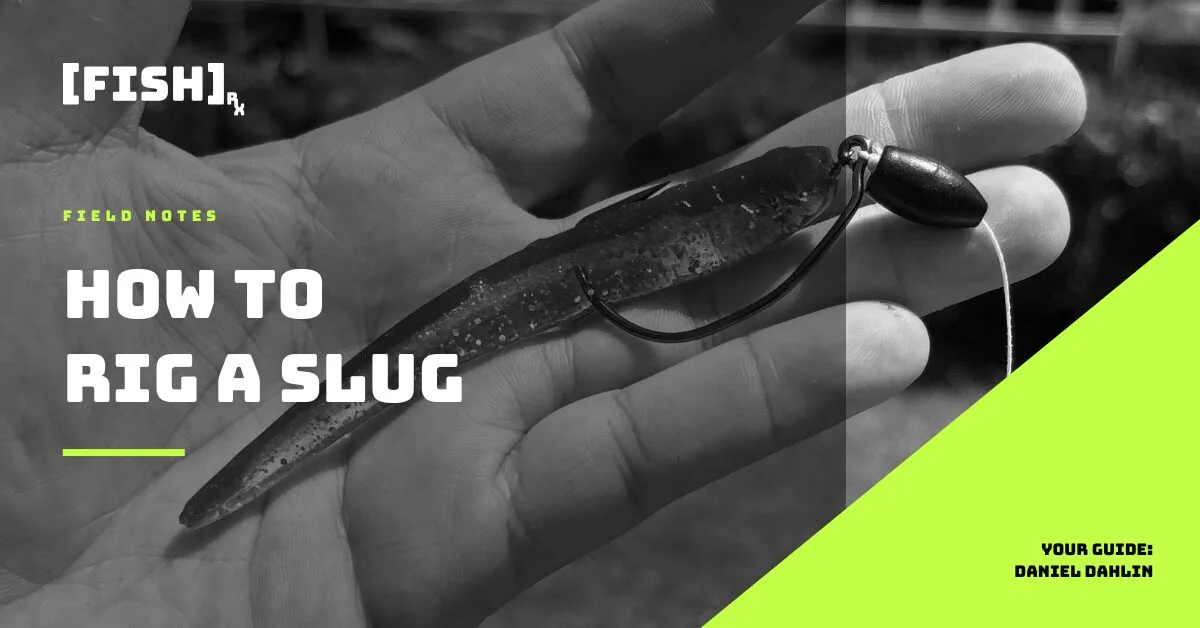
People ask what the best way to rig a slug is. The honest answer: there isn’t one. I’ve caught fish on the slug Texas-rigged, drop shot, roll head, underspin, MDR C-rig, and on many other setups just to see what would happen. That’s what I like about it. It’s a blank canvas. Whatever action you’re looking for, the slug can do it.
The drop shot is already covered in its own guide and it’s not going anywhere. It’s the first setup I tell anyone to learn. This guide covers how to rig a slug every other way: the rigs worth having in the rotation, the hook sizes that fit the bait, and when to reach for which one.
Texas rig — when in doubt, Texas rig it out
The Texas rig is one of three setups I tell people to always have tied on, alongside the jika rig and the drop shot. Year-round, any harbor, any species. Pylons, breakwalls, oil rigs, open water … it doesn’t matter. A Texas-rigged slug works everywhere.
What it gives you is bottom contact and just a little free motion from the bait not being attached to anything. You can fish it slow, pause it, and the slug still moves on its own. It doesn’t replace the drop shot. I’ll have both tied on the same session. They work alongside each other.
Hook options
The hooks I use most are from Blacktail Fishing. For a Texas-rigged slug, I’m usually on either a swim bait hook or an EWG.
The swim bait hook has a wide gap and a twist lock, which keeps the nose of the bait from blowing out on the hookset. For the 4-inch slug, start with a 1/0. For the 6-inch, a 3/0 or 5/0. One thing I like about the swim bait hook: if you want to change baits without cutting and retying, you can swap between the RX Slug, the RX Dragon Tail, and the RX Skeleton Craw all on the same hook.
The EWG works just as well: 2/0 for the 4-inch, 6/0 for the 6-inch, and that will work everywhere from back bays for spotted bay bass to the breakwall or oil rigs targeting calico. If you’re stepping up to the 8-inch slug, go at least a 6/0, and add an assist hook toward the tail, because the 8-inch gets a lot of short strikes.
Rigging it straight
Presentation is everything on any bait. If it’s crooked it spins, and you want every cast to count.
With a swim bait hook and twist lock: find the center of the head, press the lock in and twist so it sits centered. Lay the hook alongside the bait to find where the shank exits, fold the bait onto the shank, drive it through flat and even. The shank should sit flush with the body, no twist.
With an EWG: run the point into the nose and straight out through the chin. Slide the bait up to the elbow of the hook, give it a slight twist at the bend (up and over to the eye of the hook) then measure where the point re-enters the bait, fold it forward, and push the hook through. Check it lies straight before you cast.
When is the Texas rig the right call?
It’s a 365-day rig. What I reach for specifically when I want bottom contact but also a little more free motion than the drop shot gives me. The drop shot keeps the bait a couple inches off the bottom and holds it there. The Texas rig puts it on the bottom with the bait free to move on its own between hops. Different feel, different trigger. Both rigs have their days.
The Texas rig is a solid producer. The three rigs I tell people to use are jika, Texas, and drop shot. Those are powerhouse all-year-round rigs in any fishery.
Underspin — adding what people think the slug is missing
The most common thing I hear about the slug is that it doesn’t have kick. People are used to paddle tails, they want to see something vibrate, and the slug doesn’t do that on its own. The underspin fixes that.
The underspin head adds blade action underneath the bait … vibration and flash on a straight retrieve. Willow blades are tighter with more flash. Colorado blades are wider with more water movement and kick. Both get bit. On cloudy days or in chop, when fish seem to be keying on moving baits, the blades are what I reach for because of the extra vibration, flash and commotion.
One thing to check when rigging: the blade needs to hang far enough below the belly to spin freely. If it’s ticking the bait it’s not working. Drop it in the water before your first cast and watch the blade turn. That five-second check saves a session.
Size doesn’t matter much here. The 4-inch and the 6-inch both produce on the underspin. If there’s bait in the water at a specific size, match it. Otherwise fish what you have confidence in.
Tailspins — blade action at the rear
The tailspin is an accessory you add to the back of the slug. Where the underspin sits below the bait on a retrieve, the tailspin attaches at the tail end and adds flash and vibration. We carry willow and Colorado tailspin blades … same logic applies as with the underspin heads. Willow for flash, Colorado for kick and vibration.
One combination I come back to: slug on a belly weight with a tailspin attached. If you’re fishing the breakwall or around kelp, that setup keeps you weedless, keeps the bait in the strike zone, and gives you the blade action that gets attention in that kind of water.
Roll head — a lot of action with very little retrieve
The RX Roll Head is something I tell people to add to what they’re already fishing, not swap in for something else. Don’t drop the drop shot for the roll head. Pick it up alongside it.
What it does is give you a side-to-side wobble on a very slow retrieve. You can hang the bait in the water column for an extra beat, give the fish more time to commit, and the bait is still moving the whole time. You get a lot of action with a very slow retrieve back, which is why it works. Same principle as slowing down when fishing finesse, but with more visual action built in from the wobble.
To get the roll working correctly, rig the slug slightly toward the top of the bait rather than centered. That top-heavy balance is what causes the side-to-side roll when you give it the jigging retrieve … a wrist bounce on the rod that drives an up-and-down motion, which translates to a wobble on the way back. Two-tone colors are especially good on the roll head because the deep rolls show both the top and belly color switching between them quickly.
The nice part about the side-to-side roll is you get a lot of action with very little retrieve. You can hang the bait in the water column an extra second or two and that fish has one more reason to bite.
MDR C-rig — slow it down and get it close to structure
The MDR C-rig is a micro A-rig: three arms, finesse profile, designed as a tighter alternative to the full A-rig. At the Spotty Bowl tournament, five of my ten fish came on the MDR C-rig fished alongside the RX Paddle Tail. It wasn’t a bait I was in love with going in, it was just the one that confirmed itself over the course of the session.
What I’ve been doing is connecting the front of the MDR C-rig to a swing head, which makes the whole setup weedless with EWG hooks. Instead of a straight cast and retrieve, I can walk the rig over structure, hug pylons, and let the three baits react to the bottom and the cover. It fishes more like a creature bait presentation than a search bait … slower, lower, closer to the structure.
You can also straight cast and retrieve the MDR C-rig with underspins or flashy swimmers on the arms for a more traditional multi-arm approach. Both work. The weedless swing head option just opens up water you can’t get a standard A-rig into.
I use 4-inch slugs on the MDR C-rig. It’s the most universal size for numbers. Going bigger tends to weed through fish a lot more.
Scrounger head — the chuck-and-wind option
If I’m looking for a straight search retrieve with the slug, I reach for a scrounger head before the underspin (personal preference). The bill creates a side-to-side wobble on the retrieve that feels different from a blade: more subtle, less flash. The Viking Heads scrounger is the one I use.
It’s not that one is better than the other. On a calm clear day when I want a subtle presentation and a slow retrieve, the scrounger feels right. On a cloudy day with chop, the underspin’s blade comes back into the picture. Both have their window.
Jika rig — one rig for the whole session
The jika rig is the third setup in the core three, alongside the Texas and the drop shot. What I like about it is the quick-change versatility. You can go heavier without retying, swap hooks without cutting the leader, and change baits fast. One rig for the whole night while still being able to adjust. We’re going deeper on jika rigging in a separate guide, but it works with any size slug the same as a Texas rig.
Does color change by rig?
The rig doesn’t dictate the color. The water and the bite do. I’ll fish a color for 30 minutes before changing to a different color. If I know there are fish in a spot . . . and there are fish in all of our harbors. If they’re not eating, I change colors until something connects. The exception is two-tone colors on the roll head, which show really well because of the depth of the roll, but that’s about getting the most out of the roll head, not because the rig demands a specific color. For a full breakdown of which colors work in which conditions, the soft plastic colors guide covers it.
Key takeaways
- The Texas rig, jika rig, and drop shot are the three setups worth having tied on year-round. Everything else in this guide is additive to those three.
- Straight bait matters more than hook style. If the slug is crooked it spins, and a spinning slug isn’t doing what it’s supposed to.
- Size doesn’t change the logic by rig. Let the fish tell you what they want. Have the 4-inch and 6-inch both tied on and see what they’re chewing on.
Frequently asked questions
What hook size should I use to rig a slug?
For the 4-inch RX Slug, a 1/0 swim bait hook or 1/0-2/0 EWG from Blacktail Fishing. For the 6-inch, step up to a 3/0 or 5/0 swim bait hook, or a 3/0-6/0 EWG depending on the application. The 8-inch needs at least a 7/0 and benefits from an assist hook placed toward the tail to pick up short strikes.
What’s the difference between the roll head and a standard jig head for the slug?
A standard jig head gives you a vertical drop and steady retrieve. The roll head exits the weight from the bottom, making it top-heavy … when you jig it, you get side-to-side wobble instead of straight up-and-down. That gives you more action in less distance, which is ideal for working a specific spot slow rather than covering water.
Can you rig a slug weedless?
Yes. A Texas rig with a swim bait hook or EWG fishes weedless. The belly weight with a weedless hook setup also keeps the bait clear of kelp and structure. The C-rig connected to a swing head turns the whole multi-arm rig weedless and lets you walk it low along the bottom near pylons or through kelp.
![[FISH]rx RX Slug in Cosmic Shad, 4" — handcrafted soft plastic bait for SoCal inshore bass](https://fish-rx.com/wp-content/uploads/2025/11/FRXSLG-4-CSH-01.jpg)
RX Slug
The RX Slug is available in 4″, 6″, and 8″. Handcrafted in Los Angeles, tested in SoCal’s back bays and harbors.